
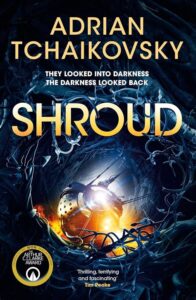
 Shroud is the second novel by Adrian Tchaikovsky that I have read. The other was Children of Time. Both had humans battling a non-human collective. Both made me think about how humans might interact with sentient non-humans. Both novels are excellent reads.
Shroud starts when a human exploration, or more appropriately, exploitation, ship discovers a dark moon hidden behind a planet. The moon is pitch black with no starlight illuminating its surface. The atmosphere is thick with gases deadly to humans. They send down probes to investigate the blackness, and nearly all of them are instantly destroyed.
A catastrophic accident occurs on part of the ship, causing some of the crew members to escape in pods designed to explore the dark world. Most of the plot then follows two inhabitants of one of those pods as they traverse the world. And what a weird world it is.
The pods’ searchlights can only illuminate a limited area around them, but what they illuminate is a mass of alien creatures; many resemble moving frames with wormlike creatures inside. The radio sphere is full of electromagnetic signals, like these aliens are using radar and constantly exchanging information with each other.
The creatures take an instant interest in the pod. Its two occupants are the engineer who designed and built the pods, and a liaison officer whose job had been to smooth relations between the various egos and fractious self-preservation desires of the crew. They fear that the alien creatures want to tear open their pod and examine its contents.
Partway through the book, we start getting a view of what is going on in the alien’s mind. A mind that is scattered into segments all over the planet and that struggles to maintain focus on what is going on around it. We slowly learn what its interest is in the pod.
The crew of the ship have been genetically bred in farms, with no concept of family or empathy for others. All they care about is their own survival. They are part of the Concern, whose only concerns are expanding throughout the universe by making a profit. Which I imagine is the path workers for today’s tech giants are on. The crew have no choice but to go along with the Concern’s pursuit of profit if they don’t want to be put back in storage.
Unless I missed it, the liaison officer’s name, gender, and physical appearance are not mentioned when they are introduced. I did not find out what sex they were until about two-thirds of the way into the book. This didn’t affect the plot or message of the book for me. I thought it could be the author playing around with the Shroud metaphor, i.e., shrouding the sex of the liaison officer. More likely it was because they did not discuss their personal lives because they had no time for personal lives.
Many science fiction stories show humanity trying to exploit the resources of an alien world with no regard for its inhabitants. But Shroud is much more than the boring, regimented, populist shit of Avatar. Humans are not out to rape a tropical paradise; they are out to destroy a world and alien species they know nothing about, and can’t communicate with. Shroud introduces a different, amazing alien species that has evolved to live in a freezing, desolate alien environment.
Shroud is a different, wonderfully imagined read. I will be reading more of Tchaikovsky’s novels.