 I went to the second weekend of the Melbourne Writer’s Festival. I am still not sure about its relatively new venue of Federation Square. It seems so sparse and sterile when compared to the crush of buzzing crowds at the Malthouse complex. I had a good time though. I was entertained as I learned about writing, publishing, and the future of the planet.
Once again, the free sessions proved just as good or better than the paid sessions. So if you’re a broke writer in Melbourne, I suggest you have a look at the guide for the free sessions when next year’s festival comes around. As there didn’t appear to be any science-fiction authors at this year’s festival, I chose sessions on subject matter, not on the authors. But I was in for a surprise when I attended a session titled License to Thrill.
License to Thrill.
The blurb in The Age for this session said:
Best-selling writers Lauren Beukes(The Shining Girls) and Terry Hayes (I am a Pilgrim) reveal the trade secrets of what makes the perfect thriller and how they master intrigue and suspense on the page.
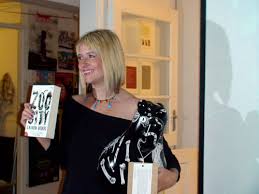
Nothing about science fiction there, but when I attended, I discovered that South African Lauren Beukes won the 2011 Arthur C. Clarke Award for her novel Zoo City. Her new novel , The Shining Girls , has a time-travel element. While Australian Terry Hayes wrote a novelisation of the movie Mad Max, co-wrote the script for Mad Max 2 and wrote the script for Mad Max 3. He was also nominated for the Bram Stoker Award for best screenplay for From Hell. But most of the elderly female audience were probably there because he wrote the two iconic mini-series: The Dismissal and Bradman.
Australian crime author Angela Savage chaired the session.
Both of the featured authors have grizzly deaths in the first few pages of their new novels, and the reader knows who the killer is very early on. They both had problems writing whodunits because readers are at different levels of deductive ability, so some work out the whodunit too early. A whodunit has to have a great ending, a great reveal. Hayes says he wasn’t confident about writing the great reveal.
Hayes said novels should show what will drive the narrative in the first ten pages. If a novel he is reading doesn’t, he will stop reading.
Hayes mentioned a comment by Alfred Hitchcock: suspense is when you expect something to happen and it does, whereas surprise is when you expect something to happen and something else happens. Hayes aimed to have the suspense and surprises increasing in intensity, with no let-up in tension, as his novel went on.
To increase tension and suspense, both used short, sharp chapters and roving POVs, often telling an incident from multiple viewpoints.
Beukes said working in children’s animation has led her to enter a scene as late as possible and exit it as soon as possible. Hayes said each scene has to have its own clarity and do what it is meant to do.
Novels need strong characters with motivations other than just being evil. Beukes said a plot without character development results in a Michael Bay movie.
They both thought it hard to make readers feel empathy for male victims. It is much easier to create reader empathy if the victim is a child or woman. (This is probably why there are so many female victims in novels.)
Beukes set her novel in Detroit because she wanted to use its decay as friction for the narrative to rub against. She interviewed several Detroit police officers. She told one police officer about the evidence in her novel, and he cracked the case. She also worked for a day in a homeless shelter in Detroit. She thought she could get away with the supernatural elements in her novel because her research had made the scaffolding of the story real.
Beukes said she used Scrivener and a corkboard to plot her novels.
And if you were wondering how long a movie script should be if you want Jerry Bruckheimer to make it: Bruckheimer didn’t bother reading a Hayes script when he saw it was over 120 pages. (This formulaic approach is probably the reason most of his movies are formulaic).
Both of the authors were good performers who spoke with clarity and humour. As a result of the session, I bought Zoo City.
My next post will be about a session on the future of publishing involving the CEOs of publishing companies Text, Scribe and Black Inc.
4 Responses
Sounds like a interesting session. I remember Terry Hayes's name from those MM films. (A page per minute of screen time is the old edict for screenplays. Not short enough for Brucky, clearly).Each to their own I suppose, in terms of methodology of writing. Whatever works I guess. They both give good advice, though depressing that if you're a man, you clearly dont matter as much. Pretty much true in terms of media coverage of war zones, crimes etc. Something women's libbers have probably never considered.
ps. I'm still not a robot, but at times, wish I was.
Hi Anthony,
I got some reassurrance from them about short chapters. The last epic manuscript I wrote had chapters ranging from 1200 to 3700 words with a mode average of 1800 words.
You know that robot thingy comes up on your blog when I comment too.
Short chapters are definitely a good idea. I use them too. I find when Im reading ill look through the next few pages and if its short, ill keep reading. SHort chapters make me read faster.
ps, im going to kill my robot. Where's my laser gun…